

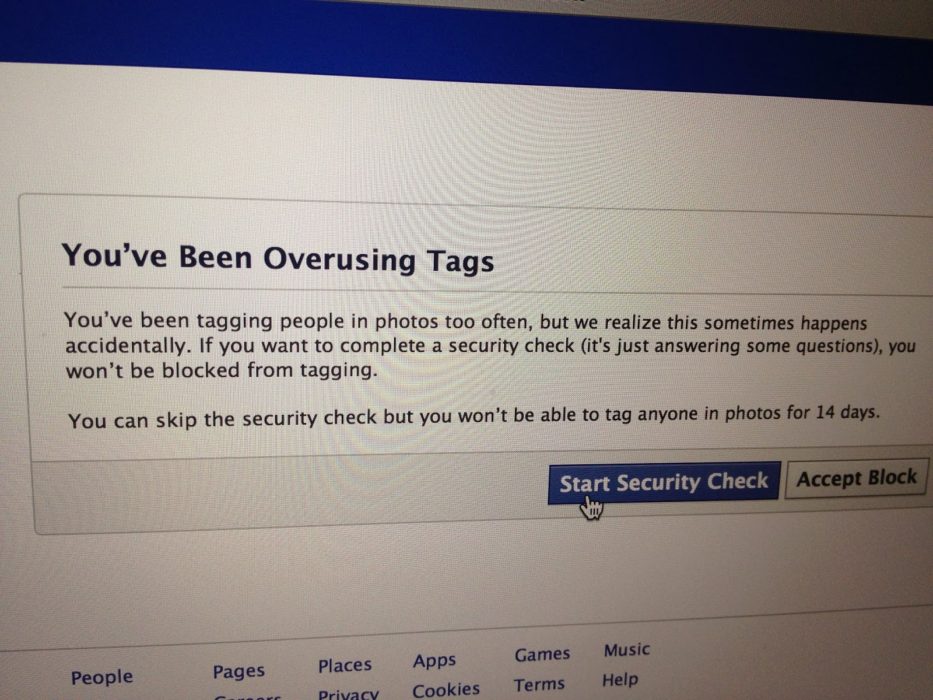
The miracle of online communication has degenerated into just typing a person’s name rather than engaging in anything resembling a meaningful conversation.
“In the last two years or so, since Facebook added the feature that allows users to tag friends, there has been a significant drop in the number of people actually talking to each other,” claimed internet expert and Head of Online Studies at Oxford University, Brian Peoples. “Now, instead of typing out a full sentence, packed with meaning and nuance, people are preferring to just blithely type the name of a friend with whom they wish to convey something.”
“Usually it happens if a link or article relates to the friend or something the friend would be interested in,” continued Brian. “For example if the link is about ketamine and your mate is a bare ket lunatic, you’ll just type his or her name and similarly if the link is about how wanking is good for the environment, you’ll tag an appropriate person.”
This isn’t the only change we’ve seen, according to the study, with most people now communicating entirely through animated gifs, smileys or thumbs up.
“I was online the other day,” offered Facebook user Sam Cleary. “I saw this link for a bloke in India who shagged a dead cow and thought ‘that’s funny, Bill will like that’. So naturally, instead of using the clunky and archaic sentence ‘hey Bill, isn’t this funny and kinda tragic?’ I just tagged his name under the piece, safe in the knowledge that he’d understand it.”
“It turned out though that he didn’t immediately grasp my meaning when I tagged his name and thought I was inferring that he’s the sort of person who’d fuck a dead cow,” continued Sam. “There was a lot of back and forth and misunderstandings, but in the end I just sent him a gif of a cat looking contrite and chastened and now we’re mates again – a point I nailed home by changing my profile pic to one of me and him together smiling.”
“Although, my girlfriend now thinks that there’s some sort of gay affair going on with me and Bill so I’m going to have to think of something to explain that – maybe I’ll tag her name under an article about platonic love.”
Brian claims it’s probably not long until this online trend begins to be mirrored in real life situations, an eventuality which will see people “ambling around in public, pointing at stuff they see while shouting each other’s names and saying saying LOL, smiley face”.
“The only thing that can save the art of conversation,” concluded Brian, “is if we come up with some sort of series of complex symbols of instantly understandable glyphs that we can teach people that, when interpreted in the brain by someone who understands them, provide meaning.”
“If only we can invent something to do just that?”


